Ntùmla Logo
HomeCultureMuseumCommunityShop
Magazine
Article
Ntùmla Logo
HomeCultureMuseumCommunityShop
Magazine
Back to Culture

Série

Protégeons notre patrimoine vivant, Nos plantes, nos terres, notre eau, nos symboles

Sommaire

1

Épisode 1 — Où sont passés nos colatiers ?Quand la kola disparaît, une mémoire disparaît avec elle

2

Épisode 2 — Où sont passées nos raphiales ? Quand nos raphiales disparaissent, nos Nkouop s’assèchent avec elles

3

Épisode 3 — L’EUCALYPTUS, LE Tueur silencieux de nos sols, de notre Biodiversite et de nos espaces cultivables

4

Épisode 4 — Le raphia : quand disparaît l’arbre, disparaît aussi une économie

Chapitre PrécédentÉpisode 3 — L’EUCALYPTUS, LE Tueur silencieux de nos sols, de notre Biodiversite et de nos espaces cultivables

Auteur

Profil→
Ntumla

Ntumla

30 septembre 2026 à 11:07

9 min116 vues40

Tags

#Architecture#Architecture vernaculaire#Raphia#Raffia#Basketry

Themes

Trees and PlantsBasketry and RaffiaDevelopment and ProjectsFarming and Harvests
PremiumFeatured

Episode 4 — Raffia: when the tree disappears, an economy disappears with it

Raffia was much more than a plant in the Grassfields: it provided building materials, everyday objects, raffia wine, and supported valuable traditional skills. Instead of abandoning this resource, we can modernize it through artistic basketry, furniture, design, architecture, and craftsmanship. Protecting and replanting our raffia groves means preserving our heritage while creating jobs, income, and opportunities for future generations.
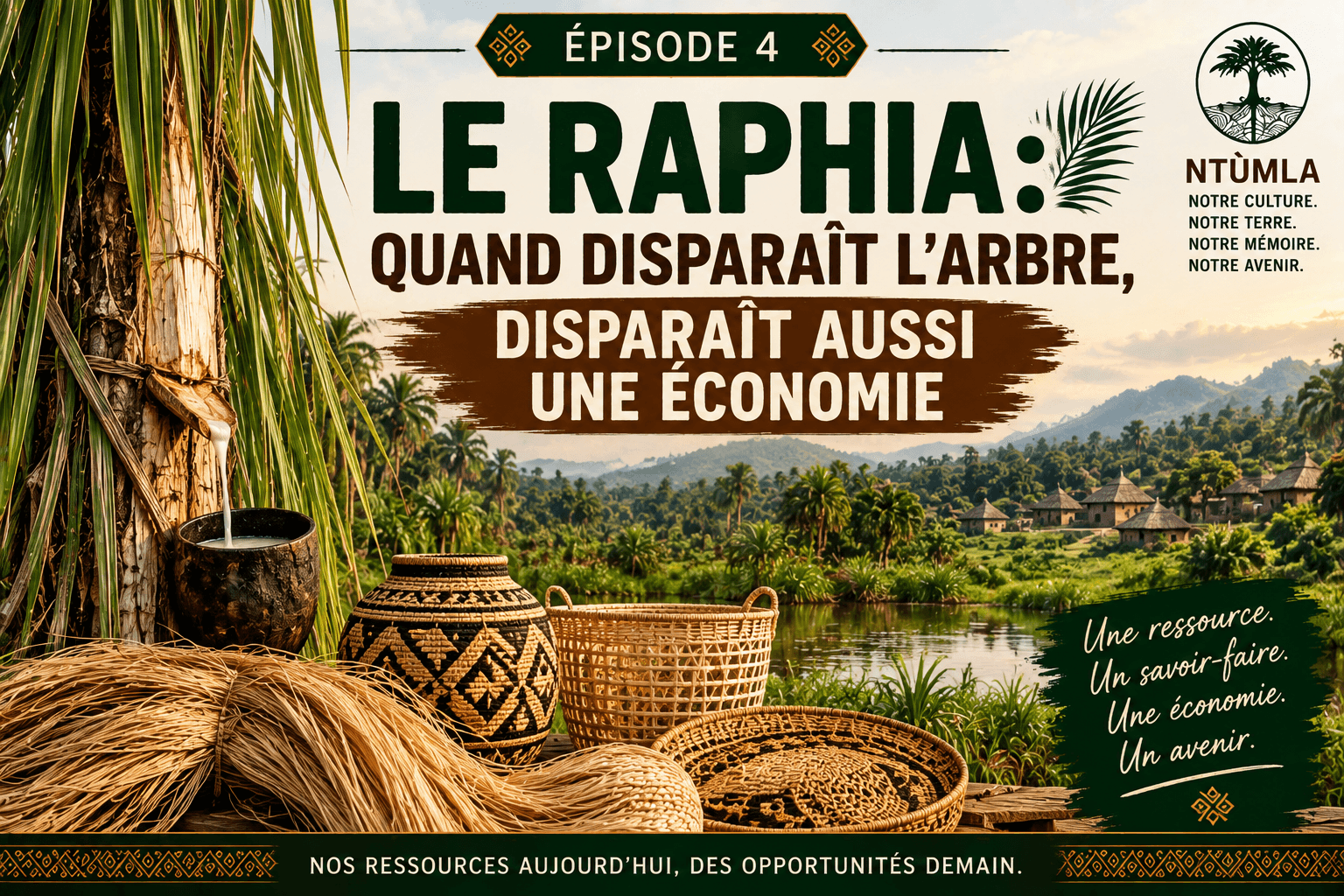
Poster 'Le raphia' (episode 4): raffia palm cut with a sap container, woven baskets and vase, village by a pond. Title: when…
Raphia

In the previous episodes, we talked about our land, our Nkouop, water, soil fertility, and eucalyptus. But one important question remains: what have we lost economically by allowing some of our traditional plants to disappear?

Raffia was never simply part of the Grassfields landscape. An entire economy existed around it. Its palms and fibers provided materials for construction, roofing, baskets, mats, everyday objects, and many forms of craftsmanship. Its sap also gave us raffia wine. A single environment could therefore support several activities, skills, and livelihoods.

We had a raw material, but we also had the knowledge to transform it

Our parents did not look at raffia as a useless tree occupying wetlands. They knew what to do with it. The farmer, the artisan, the person harvesting the wine, the person preparing the fibers, and the person selling the finished products could all participate in the same economic chain.

Chargement de votre accès premium...

Ntùmla

Bamiléké/Grassfield Foundation Non-profit organization registered in the State of Minnesota, USA © Ntùmla, 2026. All rights reserved.

Home

  • Culture
  • Museum
  • Shop
  • Community

About

  • About
  • Our Projects
  • Contact
  • Privacy
  • Terms of use

© 2026 Ntùmla. All rights reserved

Crafted by le findex